Top 10 Direct Mail Software Features for E-commerce
Inboxes are full. Banners get blocked. And your retention numbers are heading in the wrong direction.
Meanwhile, companies using direct mail are seeing conversion rates of 5 to 25% and earning 7.9 times more attention than the average email. The channel works. But only if the software behind it does too.

Dennis Koster
Marketer
Read on

There's a big difference between a printer you manually send a file to, and a direct mail software platform that connects seamlessly with your marketing stack. This article covers the 10 features that actually matter when you want to use direct mail as an automated retention and growth channel for your e-commerce business.
1. CRM integration: direct mail as an extension of your customer data
The most effective direct mail campaigns are driven by customer behavior, not assumptions. That means your direct mail software needs to pull directly from your CRM or CDP.
In practice: a customer who has bought three times but hasn't ordered in 90 days automatically receives a personalized win-back card. Without anyone lifting a finger.
Look for native integrations with platforms like HubSpot, Salesforce and Klaviyo, or an API that lets you build the connection yourself. The data already in your CRM: segments, lifecycle stages, lead scores, should be able to trigger your direct mail.
2. Ease of use and to maintain
As an e-commerce marketer, you're already juggling enough channels: email, social, ads — and the list keeps growing. Direct mail software shouldn't add to that load.
Look for a platform you set up once and that runs in the background from there. Reuse templates, build workflows once, trigger campaigns automatically based on customer behavior. No IT ticket for every send, no weekly manual work. Set it up and let it run.
2. Promo code support
If you want to use direct mail effectively, you need the ability to add discount codes to your cards. A static, generic promo code always works — but if you want to prevent your codes from ending up on discount websites, make sure your direct mail software supports unique codes per recipient.
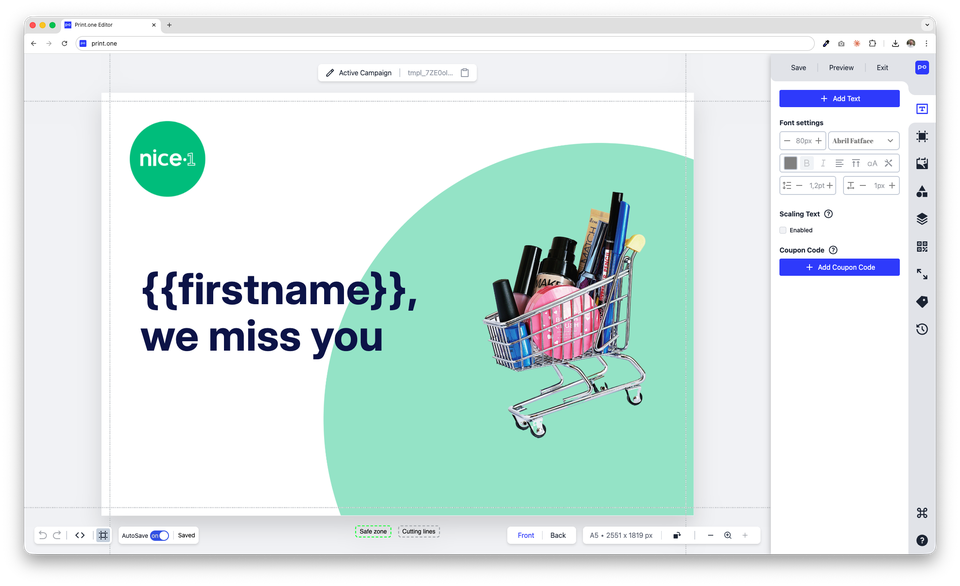
3. Personalization of both sides of your card
Mass mailings are the opposite of what makes direct mail powerful. The best platforms let you work with merge variables: each card can carry a different name, a different image, a different offer generated from customer data.
Imagine sending 10,000 cards for your loyalty program. Customer A sees their points balance. Customer B sees a product that matches her last purchase. Customer C gets a birthday discount. One campaign, thousands of variations.
That's personalized direct mail in practice. Check whether the platform supports dynamic fields and whether it has preview functionality so you can verify the variations before hitting send.
5. API-first platform for customization and scale
Got a development team? Then the quality of the API determines how far you can take things.
A good direct mail API lets you:
Send cards from your own backend or CRM workflow
Manage templates through code
Trigger print orders from tools like n8n, Make.com or Zapier
Query statuses in real time (sent, qr scanned)
The best platforms offer an API with thorough documentation, a test environment and fast implementation time. No waiting weeks for a sales process. Go live the same day.
6. Template management and design tool
Without a solid template workflow, every campaign becomes a bottleneck at your designer's desk. Look for a platform with a built-in editor that marketers can use themselves.
Key questions to ask:
Can I save templates and adjust them per campaign?
Does the platform support multiple formats (A5, A6, A4 letters, etc.)?
Can I upload my own brand colors, images, fonts and logo?
7. Scalability: from 1 card to hundreds of thousands
For an SMB, it's impractical — and expensive — to choose direct mail software that forces you into large minimum orders or long-term contracts.
Choose a platform that scales in both directions: you should be able to send a test campaign of 500 cards just as easily as a loyalty campaign of 50,000. Without needing a different contract, building a different workflow or waiting weeks.
Pay specific attention to: are there minimum order requirements? Are there subscription fees for low volumes? How fast does production run during peak periods (holidays, product launches)?
8. Tracking, analytics and attribution
Direct mail has long had the reputation of "you never know what it does." Modern direct mail software solves that.
Look for platforms with:
Unique QR codes or discount codes per recipient for direct attribution
UTM parameters you can include in the URL on your card
Campaign overviews with send volume and QR scan data
With the right tracking, you can see exactly which segment responded to which card — and run direct mail the same way you run your email campaigns: on data.
9. Reliable print execution and quality assurance
This sounds like a given — but it isn't. The best software interface in the world has no value if cards arrive crumpled, colors are off or addresses are printed incorrectly.
Look for:
Automated address validation so you know your addresses are correct
Transparency on print quality and material specifications
Address deduplication to prevent sending one recipient multiple cards
Good direct mail software is always also an operational platform. You want to know: when was my card printed, when was it sent, and when was it delivered?
10. A strong team that thinks along with you
Don't base your choice of direct mail software on features alone — look at the team that can support you in using it.
A good direct mail software provider:
Helps you think not just about how to increase conversion, but also how to optimize margin and get more out of your investment (ROI)
Is easy to reach
Shares best practices on direct mail, proactively and on request
Reviews your offer, copy and landing page together with you
Can support you in designing your cards
Together, you get to even better campaigns. Read how XXL Nutrition grew from an ROI of 380% to 718%.
In short, being able to do everything yourself with direct mail software is great — but there's real comfort in knowing a team is ready to help you get even more out of your campaigns.
Checklist: your requirements for direct mail software
Before choosing a platform, check whether it meets these minimum requirements:
✅ Native CRM integration or REST API with solid documentation
✅ Trigger-based automation based on customer behavior
✅ Variable data printing for personalization at card level
✅ Direct integration with your e-commerce platform
✅ Scalable from 1 to 100,000+ pieces without contract changes
✅ Template editor marketers can use themselves
✅ Tracking via QR codes, discount codes or UTM
✅ Transparent pricing (no hidden costs, no minimum spend)
✅ Quality assurance in the print process
✅ A capable team that can support you
Direct mail works with the right software. The right tool means you're no longer running campaigns manually, but building an automated channel that reaches the right customer at the right moment with the right message. Just like email. But one they actually read.


What are you waiting for?
Sign up now and send your first cards within 10 minutes!